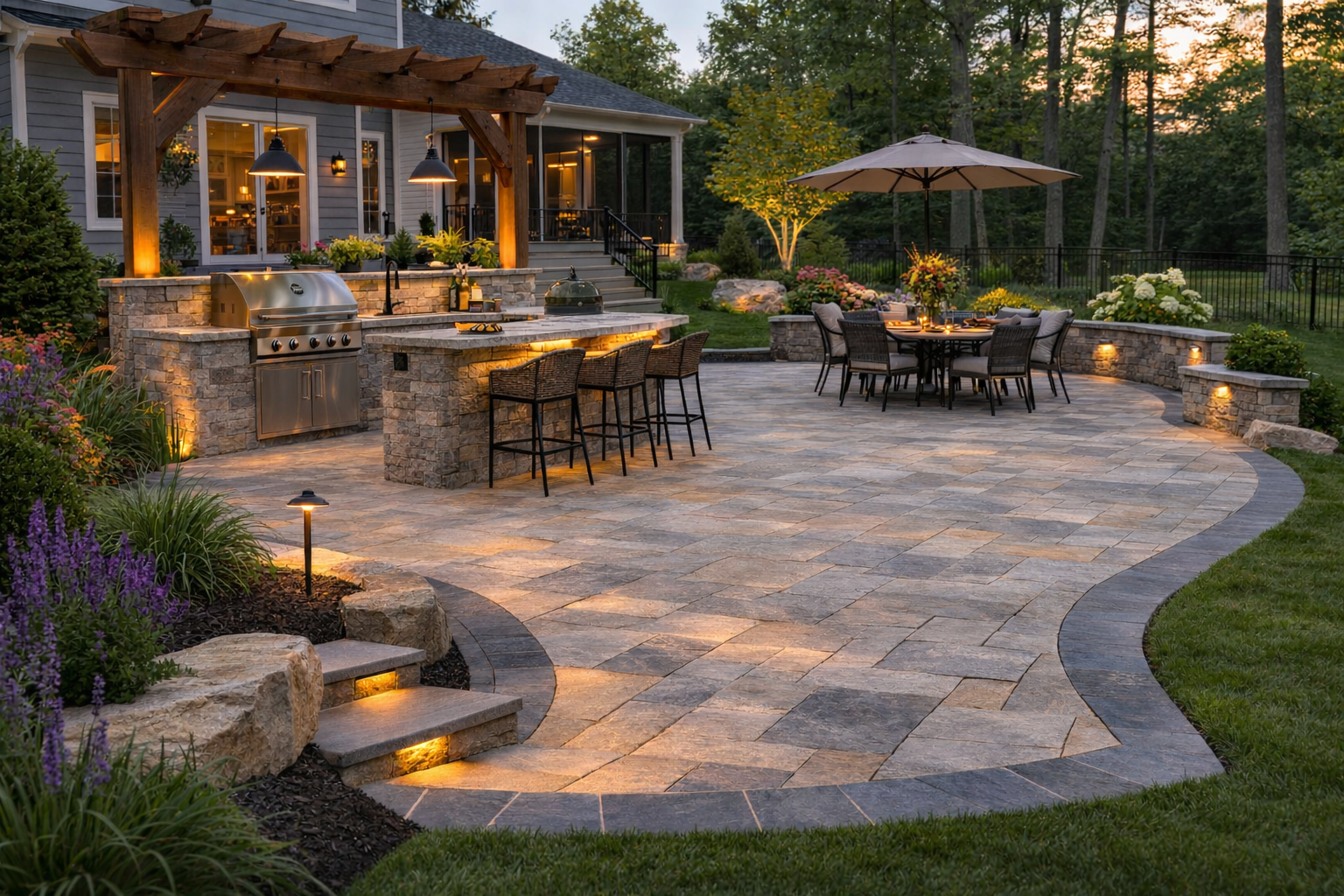
Last week, we talked about what goes beneath your pavers — the foundation that determines whether your investment lasts five years or fifty. This week, let's talk about what goes on top: the materials you'll see every day, walk on every evening, and show off every time friends come over.
Here's the challenge: Virginia's climate doesn't play nice with outdoor materials. We see summer heat in the 90s, humidity that lingers for months, winter cold that drops below freezing, and 30–50 freeze-thaw cycles every year.
Not all paver materials respond equally to that kind of stress. The right choice isn't just about color or style. It's about picking a surface that can handle Richmond's weather without losing its look, shifting underfoot, or becoming a maintenance headache.
Understanding Virginia's Climate Challenge
Before we get into specific materials, it helps to understand what they're up against here in Central Virginia:
- • Freeze-thaw cycles: Temperatures repeatedly move above and below freezing, which stresses surfaces as moisture expands and contracts.
- • Summer heat: Patio surfaces can easily reach 120–130°F in direct sun, especially with darker materials.
- • Humidity: Shaded or damp areas are more likely to collect moss, algae, and staining.
- • UV exposure: Strong sun can fade certain colors over time, especially in lower-quality concrete products.
That combination makes Virginia tough on hardscape materials. This isn't Arizona dry heat. It's not steady northern cold. It's constant change — and your material selection needs to account for that.
Material Deep Dive: Your Options Explained
Concrete Pavers: The Versatile Workhorse
Concrete pavers are the most common choice around Richmond, and for good reason. Modern pavers offer strong performance, a wide range of textures and colors, and solid value for most residential projects.
Best when: you want the best balance of durability, style flexibility, and budget for a paver patio, driveway, or walkway.
Virginia performance: Excellent — if you choose quality manufacturers with low absorption rates and freeze-thaw rated products.
Natural Stone: Timeless and Premium
Natural stone brings one-of-a-kind character that manufactured materials simply can't replicate. It feels more organic, ages gracefully, and instantly elevates the look of an outdoor space.
Best when: you're building a premium project and want something with long-term architectural value for a patio, outdoor kitchen, or retaining wall.
Virginia performance: Excellent — but only if the specific stone is appropriate for freeze-thaw conditions. Selection matters.
Brick: The Virginia Classic
Brick has a natural place in Virginia architecture. It connects beautifully with colonial, traditional, and historic-style homes — but only if you use brick pavers built for ground contact.
Best when: you want a more traditional, regionally appropriate look for a walkway, patio, or fire feature area.
Virginia performance: Very good — if you're using proper paving brick, not wall brick.
Porcelain Pavers: Modern and Low-Maintenance
Porcelain pavers are engineered for performance. They're dense, highly stain resistant, UV stable, and offer a cleaner, more contemporary look.
Best when: you want a modern aesthetic with minimal maintenance for a pool deck, permeable patio, or outdoor living space.
Virginia performance: Excellent — their low porosity makes them especially resistant to freeze-thaw damage.
We've seen homeowners get stuck choosing materials from tiny catalog photos or showroom samples under the wrong lighting. That's why we bring real samples to consultations and show materials in 3D layouts tied to your actual property. The difference between "looks good on paper" and "looks right at your house" is huge.
What We're Seeing in Central Virginia
Material trends in Richmond have shifted. Homeowners are moving away from busy patterns and warmer red-brown blends, and toward larger formats, cooler neutrals, and materials that feel more timeless.
We're also seeing more demand for permeable systems, cleaner modern textures, and premium natural stone on projects where the outdoor space is being treated like a true extension of the home instead of an afterthought.
The key is matching the material to the house, the site conditions, and how the space will actually be used. A pool deck has different demands than a front walkway. A traditional brick home calls for a different surface language than a modern build.
Questions to Ask Before You Decide
- 01. Is this product rated for freeze-thaw exposure in Virginia?
- 02. What maintenance does it require over the next 5–10 years?
- 03. Will this material stay available if I ever need repairs or additions?
- 04. How hot will it get in direct summer sun?
- 05. Can I see this material installed in a real local project?
Making the Right Choice
There isn't one perfect material for every project. There's only the right material for your home, your budget, your maintenance tolerance, and the way you want the space to feel — whether that's a patio, poolscape, outdoor kitchen, or fire feature.
What matters most is this: a premium material on a bad foundation will still fail. But the right material, installed on a proper base by a team that understands Virginia conditions, can look incredible and perform for decades. If you missed the first article, start there.
Foundation Series — Part 2 of 4
Part 1 covered what goes beneath your pavers. Part 2 helps you choose what belongs on top. Next up: real patio pricing in Richmond.